Posts

Image
Judging from the British Museum’s page, the primary purpose for the #EMOWAA project is continued colonial custody of repatriated Benin artefacts, and the custody as well of any archeological excavations in Benin, which they the British, in the name of the said proposed ‘EMOWAA’, intend on taking as on as some kind of inventory, thus continuing Britain’s legacy of looting by another name.  We are asking @governorobaseki to be clear and transparent on this difference, by which we mean, what exactly is intended for his proposed ‘EMOWAA’.  Clearly, the Oba’s Benin Royal Museum and this British Museum’s ‘emowaa’ are not the same proposal. Yet, the governor keeps failing to state exactly as much.  The 1897 artefacts do not belong to the Edo State government nor to the federation of Nigeria but rather to the spiritual and ancestral heritage of the Benin People, through the ancestral and legitimate representative of the Benin people, the Oba of Benin.  The artefacts from 189...
Image
  ESIGIE, THE SCULPTOR KING  Image:  Commemorative Head, 1500s, Benin City Material: Bronze, Iron Igun  Eronmwon Guild  Benin City Current Location: British Museum One of the thousands of looted #BeninBronzes hidden from view in storage at the British Museum. This Commemorative Head, currently not on display at the British Museum, was stolen by Felix Roth from the palace at Benin City and later sold by his brother Henry Ling Roth. The former Roth served as ‘Advance Surgeon’ during the British invasion of Benin City, 1897, while the later Rother, published, right after, the infamous work of British propaganda, ‘Great Benin; Its Customs, Art and Horrors’ in 1903. Henry Roth would then sell this stolen Commemorative Head of Oba Esigie to the British Museum.  Interesting to note both the  damage to the vertical forehead marks and the quite visible dents to face, which may have occurred during the raiding, burning and looting of the palace. *comingsoon
Image
Caption translation:   Fig. 18. Benin artist molding a group of Europeans. Photographer:     Erdmann. 1897. Text:  “Due to a particularly happy stroke of luck Mr. Erdmann himself was even able to photograph a modern Benin artist at work in 1897.  The instructive photograph is reproduced here in Fig. 18.  Similarly large reliefs appear very often in Benin serving the purpose of decorating the inner rooms; […].” (von Luschan,  Die Altertümer von Benin;   p. 26) 1897 and Erdmann the German The German foray in Africa is known for its genocide of the Herero and Nama peoples in Germany’s attempt to erase them from the face of the earth. On our West African coastline however, accounts of Germans are scant, as we all know, though not so scant as we may believe, especially as some of the surviving and earliest European accounts appear to have been written by German visitors and/or traders on the West African coastline. It would seem that on our c...
Image
The Ugly Warrior who saw the nymph Agbagbon with his naked eye, the punishment of Oboro-Uku and how the abduction of Adesuwa caused a war… The Esigie ban on the sale of humans was fully effective as early as 1516 for both genders. However in the mid to late 1700s, during the reign of Oba Akengbuda, the kingdom suddenly allowed itself to participate in a trade that Esigie had decreed forbidden. Why?  Let us recall firstly that the 1700s was the zenith of the European Slave Trade on the West African coastline and that, for much of the up and coming merchant European class, the sale of Africans was one of the most profitable and colony expanding enterprise. Whereas for the so-called ’Great Benin’ mentioned in pre-1600s texts, in adhering to its beloved king’s century old ban on the trade, experienced rapidly receding boundaries with the advent of slaving European traders stationed all around the outskirts of its fast shrinking empire.  Why then did the reclusive kingdom, refusing...
Image
  Disk Of Life / Plenitude, 1700s, Benin Kingdom   Royal Bronze-casting Guild (Igun Eronmwon), Benin City Size: 1 × 1/16 × 24 in. (2.54 × 0.203 × 61 cm) Recurring Benin Arts motifs hammered on metal in low relief. Material: Brass plate More info : click here   Note: Would really be nice if the current sculptors at Igun Eronmwon guild revisit this disk.  Quite wonderful to find a kind of synchronicity of similar images from all over the world, from Asia to the civilizations in the Americas, etc: CLICK here to see DISKS from all over the world. 
Image
A brief history here of Benin Empire with a focus on the arts and the Benin artefacts from a project put together by Black Brits in  partnership project with  museums in Greater Manchester: The empire of Benin and its cultural heritage by Kuljit 'Kooj' Chuhan The ancient kingdom of Benin began around AD900 although some sources suggest much earlier dates. From its base located in what is now Nigeria, it became a large empire and by around the fifteenth century some sources say that it stretched from Sierra Leone to as far as Congo. Its people were known as the Edo and they were ruled by an Oba (king). High quality arts Benin was, and still is, famous for its oral history traditions and for its highly skilled craftsmanship and arts, especially wood carving, weaving and brass casting. Brass casting reached a particularly high level of aesthetic and technical sophistication in the sixteenth century when decorative plaques and sculptures (now known as ‘The Benin bronzes’) were ma...
Image
  MEANING, THEMES AND MESSAGES THE USE of THEMES to declare awareness of trials and travails. (more on this soon) IMAGE: 18th/19th century Helmet, Benin Empire The Benin Arts motif  of endless interlocking marks lace the lower part or base of the helmet. Spread along the vertical side towards the top is the recurring theme of ‘Bird of Prophecy’. Here the bird of prophesy is actively attacking a snake-like form also positioned at the top and which may or may not be an extension of the frontal ram-horse head that is, like the base of the helmet, decorated at the mouth with motifs of endless interlocking marks. The horse-like or ram headed frontal piece also carries decorative pair of horns. What trials are being pointed to here?  A later era piece, this helmet was attributed to Ife by the Brits or some indifferent curator. In terms of the British it was usual practice for them to mis-attribute Benin Arts to Ife as part of the propaganda to erase the Benin Kingdom...
Image
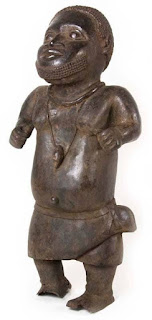
THE DATING OF THE DWARF It is often the practice of extant texts on the looted arts of the kingdom of Benin to merely assume that the history of the kingdom and its empire began in the 15th century. Often, this indifference to properly date the art and objects stolen from the kingdom serves the European or white supremacist idea that the arts of Benin are due the Portuguese arrival — a bold face error that to date continues to be the practice by the museums. The accompanying texts are lazily repeated, in a style no different from cut and paste. The dwarf here is a case in point. According to the Art Institute of Chicago , "Dwarfs have functioned as court jesters in Benin since the 15th century." (Italics ours) But this preposition cannot be true. Dwarfs have been a staple of Benin Arts from the Ogiso era and became more universally popular as art subjects during the expansion of the kingdom in the 1300s, i.e. Oba Ewuare's reign proper and earlier, ie before the fixated...
Image
 Enogie of Obazuwa’s letter to the Art Institute of Chicago, 2008, with some details of the long fight to repatriate the looted #BeninBronzes back to Benin. re #LootedArt #BeninBronzes re #LootedArt #BeninBronzes
Image
 ARTICLE 4 Olfert Dapper was a Dutch physician and writer who never travelled out of the Netherlands even as his Description of Africa , published in 1668 became, for the next couple of centuries, the go to text for outsiders (ie Europeans, many of whom were potential slave traders, including the emerging mercantile class of ‘gentleman scholar’ common in Europe at the time) seeking to learn of Africa or the kingdoms of Africa. Though he never visited any kingdom in Africa, certainly not West Africa, Olfert Dapper relied heavily on the records of the Dutch West India Company, a trading company that began to ply the West African coastline in the early 1600s and throughout the hotbed period of European slave trade. The period of 1600s, 1700s and all through the early 1800s was not only the most prolific in the trade of Africans by the Europeans, it was also a time when Oba Esigie's ban on the trade of humans was set fully in place in the kingdom of Benin, having been put in placed du...