Posts

Image
  Disk Of Life / Plenitude, 1700s, Benin Kingdom   Royal Bronze-casting Guild (Igun Eronmwon), Benin City Size: 1 × 1/16 × 24 in. (2.54 × 0.203 × 61 cm) Recurring Benin Arts motifs hammered on metal in low relief. Material: Brass plate More info : click here   Note: Would really be nice if the current sculptors at Igun Eronmwon guild revisit this disk.  Quite wonderful to find a kind of synchronicity of similar images from all over the world, from Asia to the civilizations in the Americas, etc: CLICK here to see DISKS from all over the world. 
Image
A brief history here of Benin Empire with a focus on the arts and the Benin artefacts from a project put together by Black Brits in  partnership project with  museums in Greater Manchester: The empire of Benin and its cultural heritage by Kuljit 'Kooj' Chuhan The ancient kingdom of Benin began around AD900 although some sources suggest much earlier dates. From its base located in what is now Nigeria, it became a large empire and by around the fifteenth century some sources say that it stretched from Sierra Leone to as far as Congo. Its people were known as the Edo and they were ruled by an Oba (king). High quality arts Benin was, and still is, famous for its oral history traditions and for its highly skilled craftsmanship and arts, especially wood carving, weaving and brass casting. Brass casting reached a particularly high level of aesthetic and technical sophistication in the sixteenth century when decorative plaques and sculptures (now known as ‘The Benin bronzes’) were ma...
Image
  MEANING, THEMES AND MESSAGES THE USE of THEMES to declare awareness of trials and travails. (more on this soon) IMAGE: 18th/19th century Helmet, Benin Empire The Benin Arts motif  of endless interlocking marks lace the lower part or base of the helmet. Spread along the vertical side towards the top is the recurring theme of ‘Bird of Prophecy’. Here the bird of prophesy is actively attacking a snake-like form also positioned at the top and which may or may not be an extension of the frontal ram-horse head that is, like the base of the helmet, decorated at the mouth with motifs of endless interlocking marks. The horse-like or ram headed frontal piece also carries decorative pair of horns. What trials are being pointed to here?  A later era piece, this helmet was attributed to Ife by the Brits or some indifferent curator. In terms of the British it was usual practice for them to mis-attribute Benin Arts to Ife as part of the propaganda to erase the Benin Kingdom...
Image
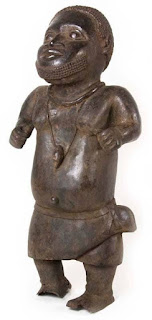
THE DATING OF THE DWARF It is often the practice of extant texts on the looted arts of the kingdom of Benin to merely assume that the history of the kingdom and its empire began in the 15th century. Often, this indifference to properly date the art and objects stolen from the kingdom serves the European or white supremacist idea that the arts of Benin are due the Portuguese arrival — a bold face error that to date continues to be the practice by the museums. The accompanying texts are lazily repeated, in a style no different from cut and paste. The dwarf here is a case in point. According to the Art Institute of Chicago , "Dwarfs have functioned as court jesters in Benin since the 15th century." (Italics ours) But this preposition cannot be true. Dwarfs have been a staple of Benin Arts from the Ogiso era and became more universally popular as art subjects during the expansion of the kingdom in the 1300s, i.e. Oba Ewuare's reign proper and earlier, ie before the fixated...
Image
 Enogie of Obazuwa’s letter to the Art Institute of Chicago, 2008, with some details of the long fight to repatriate the looted #BeninBronzes back to Benin. re #LootedArt #BeninBronzes re #LootedArt #BeninBronzes
Image
 ARTICLE 4 Olfert Dapper was a Dutch physician and writer who never travelled out of the Netherlands even as his Description of Africa , published in 1668 became, for the next couple of centuries, the go to text for outsiders (ie Europeans, many of whom were potential slave traders, including the emerging mercantile class of ‘gentleman scholar’ common in Europe at the time) seeking to learn of Africa or the kingdoms of Africa. Though he never visited any kingdom in Africa, certainly not West Africa, Olfert Dapper relied heavily on the records of the Dutch West India Company, a trading company that began to ply the West African coastline in the early 1600s and throughout the hotbed period of European slave trade. The period of 1600s, 1700s and all through the early 1800s was not only the most prolific in the trade of Africans by the Europeans, it was also a time when Oba Esigie's ban on the trade of humans was set fully in place in the kingdom of Benin, having been put in placed du...
Image
On Esien Edo (BENIN PEPPER) and co. APROPOS: OUR NOTE on the excerpts/article below: Considering that cultural, every day items such as the ‘ ‘Benin Cloth’ 'Benin Soap'  are of great interest to us, the excerpt below on ’BENIN PEPPER’, which we found from searching after an image, was right along things dear to this blog. The question in these findings is often that of loss as specific knowledge industry has either been lost or shrugged off by the people themselves, either from the conveniences and exploitative caprices of the particular style of consumer modernity that fell upon emerging African nations ( and from which they were formed ) or, in this context of the Benins, the weight of overwhelming propaganda against which the kingdom and its founding ethnic tribe has had to deal.  Regarding the propaganda itself, it was a relief too to find an actual mention of the royal courtly coral beads as an actual  expor t item of the day. This has always been the oral history as...
Image
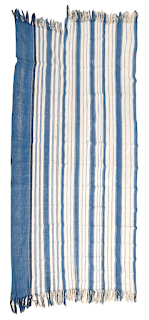
The ‘BENIN CLOTH’ : A Very Brief History of A Forgotten Textile Economy  When the Benin-Portugal factory opened at Gwatto (Ughoton) at the tail end of the 1400s, it was precisely for the exchange of material culture. The slave trade had not started and the world was still innocent as yet and among other items of exchanges, Benin Cloth, manufactured by the Benins, was an important     item of export economy and thousands of yards of Benin Cloth were exported to Portugal, then later through the Dutch Company.   Global Textile Trade: In 1505 alone, B Fernandez of Portugal, one of the main buyers, purchased just under 2000 bundles of cloth from the factory at Gwatto. Who were the makers of these cloth such that one buyer could purchase that many cloth? Reports suggests the weavers were mostly women, weaving from looms set up in their own homes. In 1506 when Oba Esigie closed down the factory, it was precisely because the trade had suddenly shifted from exchange of materi...