Posts

Image
On Esien Edo (BENIN PEPPER) and co. APROPOS: OUR NOTE on the excerpts/article below: Considering that cultural, every day items such as the ‘ ‘Benin Cloth’ 'Benin Soap'  are of great interest to us, the excerpt below on ’BENIN PEPPER’, which we found from searching after an image, was right along things dear to this blog. The question in these findings is often that of loss as specific knowledge industry has either been lost or shrugged off by the people themselves, either from the conveniences and exploitative caprices of the particular style of consumer modernity that fell upon emerging African nations ( and from which they were formed ) or, in this context of the Benins, the weight of overwhelming propaganda against which the kingdom and its founding ethnic tribe has had to deal.  Regarding the propaganda itself, it was a relief too to find an actual mention of the royal courtly coral beads as an actual  expor t item of the day. This has always been the oral history as...
Image
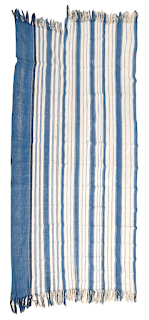
The ‘BENIN CLOTH’ : A Very Brief History of A Forgotten Textile Economy  When the Benin-Portugal factory opened at Gwatto (Ughoton) at the tail end of the 1400s, it was precisely for the exchange of material culture. The slave trade had not started and the world was still innocent as yet and among other items of exchanges, Benin Cloth, manufactured by the Benins, was an important     item of export economy and thousands of yards of Benin Cloth were exported to Portugal, then later through the Dutch Company.   Global Textile Trade: In 1505 alone, B Fernandez of Portugal, one of the main buyers, purchased just under 2000 bundles of cloth from the factory at Gwatto. Who were the makers of these cloth such that one buyer could purchase that many cloth? Reports suggests the weavers were mostly women, weaving from looms set up in their own homes. In 1506 when Oba Esigie closed down the factory, it was precisely because the trade had suddenly shifted from exchange of materi...
Image
ARTICLE 3  EVERY DAY THINGS AND THE OBJECTS OF LIVING: Hand lamps in the city … “The open compounds at night, full of people and lit up with these lamps, were very striking…” TEXT:  FIG. 126. A Benin Hand-Lamp. Every arm has a different design (see Fig. 122) and is about half and inch or 12 mm. wide; two of the arms are cracked and have been rivetted together by means of pieces of brass plate (a) and copper rivets (b). The diameter of the pan is about 15 inches (38 centimetres). It will be observed that the two hawkbells depending above the mannikins are of different pattern from those handing on the snuffer fig. 127, the ornamentation being zigzag on one of the two and arched on the other. I have elsewhere pointed out that one of the dominant features of Benin art is its variety. “All the gentry had these lamps. Palm oil was put in the pan, and a piece of raw cotton wool placed on the edge of the pan served as a wick; a small flat piece of iron was placed on the top of the wi...
Image
ARTICLE X The British Pre and post colonial Propaganda Against the Benin Empire.  The Benin Empire was the only West African kingdom that rejected the transatlantic slave trade. For over 350years and starting with Oba Esigie in the 1506, ie before the European Slave Trade took hold, the kingdom resisted the Europeans hankering at its borders for a supply of humans. The European Slave Trade, which lasted for 400 years only to break into the so-called 'colonization of Africa', was anticipated by Esigie who, as early as 1516, had a full ban in place. Yet, or precisely for these reasons, a long and feverish propaganda was begun  by the Brits to insinuate the Benin Kingdom in a smear campaign eagerly consumed by the colonizers themselves and the newly minted 'colonized',  eager to acquiesce to the smearing of fellow Africans .  After the invasion of 1897, the propaganda took flight in malicious print publications touted as 'history books' by the likes of Ling Roth, w...
Image
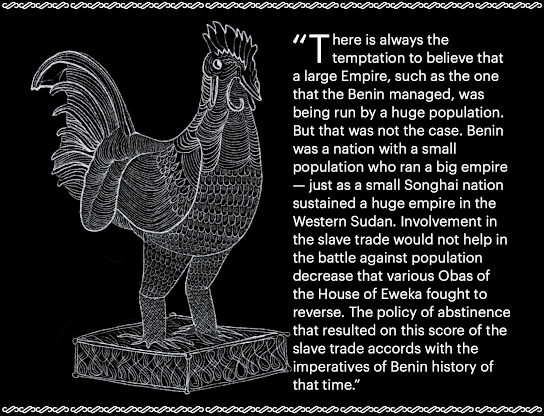
What was the position of the Benin Kingdom during the European Slave Trade? The standard historical narrative, sold by the victors of the Slave Trade, the British, has always been that by dint of being one of Africa's more powerful kingdoms and empire of its day, the Benin Kingdom was a centre of the trade (ergo, Britain the liberator of the horrible acts of the Africans). Yet the contrary is in fact what happened, which is that precisely because Benin Kingdom was powerful, it was exactly positioned to reject and it in fact rejected the European Slave Trade of which Britain was a paragon slaver/dealer.  From Ryder to Ekeh, the false, propagandist narrative created by and large by Britain has since been debunked.                           PETER EKEH, lecture at the BENIN INSTITUTE OGISO TIMES AND EWEKA TIMES: A PRELIMINARY HISTORY OF THE EDOID COMPLEX OF CULTURES In many ways, this lecture is a cele...