Posts

Image
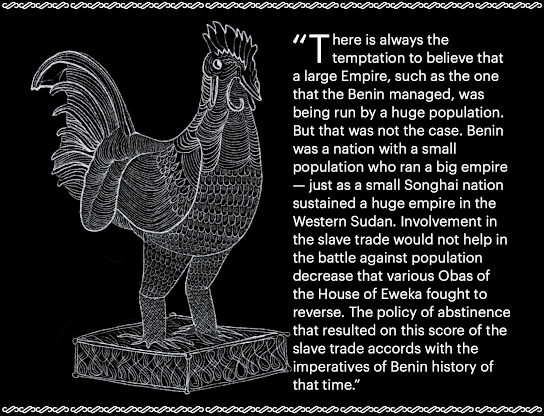
What was the position of the Benin Kingdom during the European Slave Trade? The standard historical narrative, sold by the victors of the Slave Trade, the British, has always been that by dint of being one of Africa's more powerful kingdoms and empire of its day, the Benin Kingdom was a centre of the trade (ergo, Britain the liberator of the horrible acts of the Africans). Yet the contrary is in fact what happened, which is that precisely because Benin Kingdom was powerful, it was exactly positioned to reject and it in fact rejected the European Slave Trade of which Britain was a paragon slaver/dealer.  From Ryder to Ekeh, the false, propagandist narrative created by and large by Britain has since been debunked.                           PETER EKEH, lecture at the BENIN INSTITUTE OGISO TIMES AND EWEKA TIMES: A PRELIMINARY HISTORY OF THE EDOID COMPLEX OF CULTURES In many ways, this lecture is a cele...
Image
  ARTICLE 2c. The city deserted on the day of burning, looting and destruction 1897 by invaders. The images of a city deserted on that day. Notice the horizontal ribbed indents running across the wall. Location: Benin City Date: 1897 Photographed by one of the British looters
Image
  ARTICLE 2b. Images of the burnt city. The British looting and burning went far beyond the palace as they sought to destroy the ancient city in total -- which was then promptly photographed by themselves to show, in that book by the British propagandist, L. Roth, 'how dirty the Africans were'. The first image is of a street in the ancient city, Benin City. The burnt pillar manages to retain the stylized emblems. Notice use of the 'bird of prophesy' as decoration at its base. This motif of the bird seems to have been used at entrances. Notice also the decorative striations on the sides of the pillars in the first image, which is Edo Architecture proper — though many groups all across the region (ie as far west as the Ewe and Asante in Ghana ) share very similar architecture, such as pillars and the low relief decorations on altars (see in the second image). The horizon ribbed indentations however appear to be particular to Edo Architecture Both images were photographe...
Image
  ARTICLE 2a The burnt remains of a ruined doorway leading into a family compound. / The image of the doorway in the document below, is from a photograph taken by one of the looters on that day in 1987 and is ironically an example of how the invaders went to great length to record their destruction of Life and Arts and Architecture of the Benin Empire supposedly to 'show' how laid to waste or 'dirty' the ancient city was. For example, what the invaders referred to as 'ditch' was an elaborate moat system, often with inlaid steps and which were fortified by Oba Esigie in the late 1500s in great foresight upon realizing that the subkingdoms under the Benin Empire had all been lost as if overnight and a new form of personality was being groomed by the Europeans as 'chief'. To Esigie's mind, the debilitating trade was essentially robbing his kingdom of the vast people under the empire built by his grandfather. In a bid to stop the new and fast arriving ...